
4.3 Introduction to Self-governance and personal autonomy
SIMPLE BUT EFFECTIVE WAY GETTING STARTED WITH THE PEDAGOGICAL PROCESS TOWARDS GREATER & MORE SELF-DETERMINATION FOR THE CITIZEN.
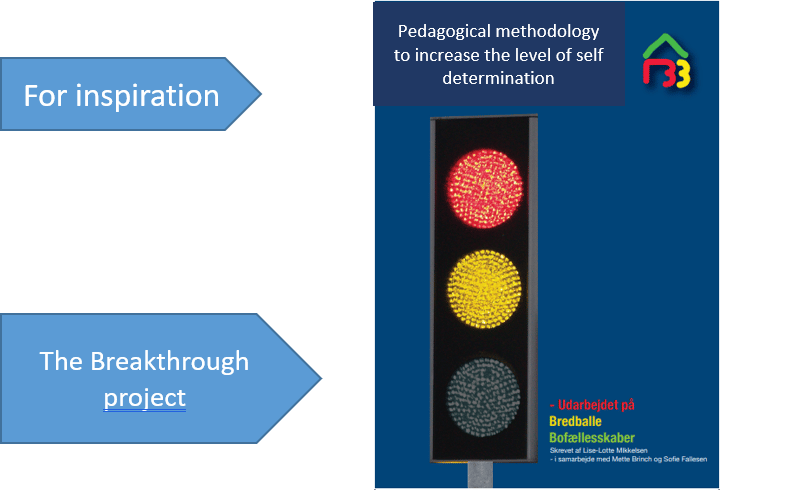
Here we present you with a very simple and simple course for how to get started with the pedagogical work that will strengthen citizens’ opportunities in practice to unfold and increase their right to self-determination, the right to co-determination and greater personal autonomy.
The course was taken from a Danish residence – and was directly translated into English called “Breaking Through Project”
https://viden.sl.dk/media/7466/bredballe_paedagogisk-metode.pdf
Preface
Bredballe Housing Communities , which is located in Denmark, has since its inception in 1985 tried to ensure the individual resident as high a degree of self-determination as possible.
This starting point has been central to the organisation of the individual’s daily life.
In the beginning, the options were perhaps limited to choosing between the offers that were either presented or selected by the Pedagogical/social workers, to know that the residents have a say in what help you want and how and when you want it. Taking into account the individual’s prerequisites, we have therefore worked to develop methods that ensure this.

To a large extent, these methods are individual.
Our aim has been to increase individual selfdetermination by means of the G-break method.
Our focus has been to find what is most important for the individual to decide for himself.
The purpose of this guide is partly to describe the methods we have used in connection with increasing the individual’s self-determination, and partly to make the description useful for others who want to work with self-determination.
The present material therefore contains both experiences from Bredballe Cohousing and a guide describing how and with what means can be worked to increase the individual’s self-determination.
The guide is divided into three sections.
The first section describes how Bredballe Housing Communities has worked with self-determination.
Section two discusses a model for how other services can organise their efforts for increased user involvement.
In section three, some of the tools that Bredballe Cohousing has developed follow.

1. Description of the project
Self-determination as a concept can be difficult to understand.
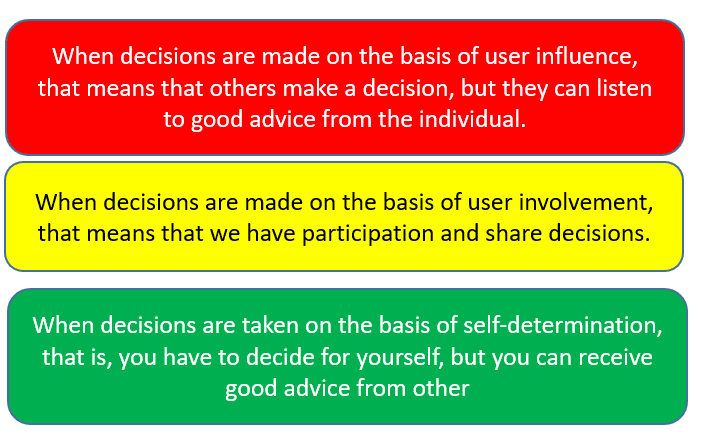
We make decisions at different levels and distinguish between self-determination, user involvement and user influence.
This requires that the tongue is held straight in the mouth when the meaning of the terms is to be clarified in practice.
Visualisation facilitates understanding to some extent and therefore the colours from the traffic light are used as visual support.
The three concepts are therefore defined and presented as follows:
A pedagogical challenge
The pedagogical task is to translate these concepts into examples from everyday life and use the concepts in collaboration with the learning disabled, in order to make visible the decisions and agreements made in the individual’s own life.
The terms can also be used when defining democratic processes.
We have chosen that the focus must necessarily be to find the decisions that have the greatest impact on the individual to decide for himself. In the following, we will review the approach and method we have worked with in the Breakthrough Project in 2006.
In the attempt to implement the conceptual understanding of influence at the three levels, all sails were set to make the project visible.
It’s no secret that the project has been anything but a sufficient disruption to some extent.

It has been a tall order.
Development up to a course in the start-up phase of the Anniversary Project, dissemination of the project has been a matter of information at staff and residents’ meetings.
Let us face up to reality. Not everyone had a clear picture of the project’s purpose.
Perhaps even fewer people had a picture of the extent of the work to be planned and carried out in connection with the project.
In the project group, we quickly agreed that we had to start the project with a course.
It was necessary that there was a starting point for the project.
In the project group, we depended on the professional organisation of all Pedagogical/social workers.
The breakthrough method had to be spread so that all Pedagogical/social workers had ownership. Finally, it was also the idea that in the work of developing individual communication methods, we would not get anywhere if the task was not placed in the hands of contact teams.
Each contact team had to assess how they would approach the task in order to support the individual resident in becoming more aware.
We therefore chose to divide the project into phases.
1. First phase – start-up phase

Here, both residents and employees were informed.
However, it was the project team that worked.
In the project group, we planned the process while testing whether the methods we wanted to develop could work.
During this phase, weekly meetings were held where the pedagogical method development and professional planning took place. Here only employees and manager participated.
In addition, meetings were held with the residents’ representatives.
They had been chosen by their comrades to sit in the group.
The task at the meetings was in the start-up phase to be involved in the course planning.
In addition, the residents have informed about the group’s work at the residents’ meetings.
It was also clarified that the course would consist of two training days one week apart.

Before the course, all contact teams had been introduced to the breakthrough method.
They had been tasked with developing individual communication methods to support each resident, who should be ready for the days after the first day of training.
We had chosen that the 1st course day, where all residents and contact Pedagogical/social workers were participants, should be the starting point for everyone’s involvement.
This is to ensure that when measuring our results, it would be crucial that the people participating in the project are roughly the same distance.
In the week after the 1st day of the course, all residents were helped to express what is important for the individual to decide for himself.
After a week, all residents participated in the 2nd day of the course, where their wishes for change were processed.
After the course days, the task was to make action plans on the many wishes expressed by the residents.
 In addition, the methods that have optimised the individual’s prerequisites for articulating desires for self-determination had to be processed, described and included as part of a pedagogical method for use in similar tasks.
A successful course at Bredballe Housing Communities
Inspiration and celebration go hand in hand.
We had no doubt that a course would be a success on a social level.
Who doesn’t love a good party.
But whether the course would also have an impact on the “academic” outcome was more uncertain.
The necessary considerations
When, in the work with mentally disabled people, you have to organise educational courses that can accommodate 18 people’s different prerequisites for understanding the message, it will require specially designed individual support.
We settled on a level that we expected to be broad, and in addition, we prioritised a high level of individual support throughout the process.
The objectives of the course were: · Raising young people’s awareness of their own rights ·
To increase young people’s awareness of when decisions are made on the basis of: User influence, user involvement and self-determination in relation to their own lives ·
To become aware of what is important for the individual to decide for himself.

The 1. Course day
We left on the 1st day of the course, which was planned with the goal of inspiring the participants.
Here Team Skovly came and talked about how they work with the three concepts and the color code described earlier.
Team Skovly was Ribe County’s project group in the Breakthrough Project.
At Skovly, they had worked with the same definition as we have chosen, and during the project period they wanted to practice the residents’ ability to communicate the content and difference between the three levels of determination.
It was the first time the three young mentally disabled people from Team Skovly gave their presentation to like-minded people.
Likewise, Lisbeth Jensen from Ulf (National Association of Mentally Disabled People) came and told about the rights of mentally disabled people.
After the presentations was a question and answer session.
 First, however, the 18 young people needed help to translate the proposal into questions.
Questions that put their own influence at different levels in relief (see conversation form under Appendix).
The day ended with a party.
We left on the 1st day of the course, which was planned with the goal of inspiring the participants.
Processing of the 1st day of the course and preparation for the 2nd day of the course.
The following days after the 1st day of the course, the residents were interviewed.
Time was set aside for this, in both the residents’ and the teachers’ calendars.
It was alpha and omega that everyone had the material that would take the development work forward.
The goal, as described above, was to find out what is important for the individual to decide for himself.
In a self-determination scheme, a large number of decisions were defined.
The self-determination form is a key document in the project, where decisions are subordinated to the decision levels.
Some decisions assessed the resident, being made at the right level.
- That is, the resident agreed and satisfied with:
- That others had made the decision for the resident
- That the decision was made in collaboration with the Pedagogical/social workers or others
- That the decision was made on the basis of self-determination
2nd Course day
Each resident brought their self-determination forms to the 2nd day of the course the following week.
Here, all residents plus the project group were on a course.
Each resident, with the help of a course leader, presented his wish to the group.
Depending on the prerequisites, the resident could come up with solutions himself.

For this purpose, the individual had brought the communicative support tools that had been developed.
After the presentation, they were asked if they wanted to hear their roommates’ good ideas.
In the evaluation after the course day, many people expressed that it had been fun to hear what the friends suggested.
In this process, the individual resident should become aware of how he or she could move forward with the desires for self-determination he or she may have.
In order for the process to be of value to the individual, as previously mentioned in connection with the preparation before the 1st day of the course, it became the task of the contact persons to plan, test and develop methods that ensure the greatest possible individual support for the individual.
These methods were described in a guide for the staff, where the experience of the project group was formulated.
Guide and timetable for project for increased self-determination
The following outlines the timetable that Bredballe Co-housing has followed in the project process.
The dates and phasing are indicative.
Phase 1.
Start-up and planning:January 1 – April 15 (3 1/2 months)
- Ongoing information about the project at staff meetings and residents’ meetings
- Weekly meetings for project staff
- Planning and testing of pedagogical methods
- Description of pedagogical methods
- Meetings as needed with resident representatives
- Planning the practical details of the kring course
Phase 2.
Course completion 15 April – 15 June (3 months)
- Weekly meetings of the project team
- Joint discussions at staff and investment meetings
- Preparation and dissemination of methods to the responsible Pedagogical/social workers
- The contact Pedagogical/social workers plan, test and prepare pedagogical method · 1st day/inspiration day
- Interview of the residents. Identify the wishes that the resident should bring to the 2nd day of the course:
- What is the most important thing to decide for himself 2nd day of training
Phase 3. Action plan and documentation
August – December (5 months)
- Weekly meetings of the project team
- Joint discussions at staff meetings and residents’ meetings
- Action plans are prepared by the contact teacher, as far as possible in collaboration with the young person
- The individual methods are described
- Documentation for the resident is prepared
Inspiration and guidelines for the pedagogical work

In connection with the first phase of the project, we prepared an inspiration booklet for the contact groups.
They had to start organising the pedagogical method, and based on the experiences we made and the tests we had carried out, we had prepared an inspiration booklet with guidelines for interviewing the residents and the framework around the interview.
Inspiration for the interview and the interview situation
Each contact group must have an individual method adapted to the resident before the 1st day of the course.
This method should aim for you to conduct an interview with as high a degree of validity as possible so that we can achieve the set goals for the individual.
The person conducting the interview is responsible for the final organisation. The team is based on the individual’s prerequisites.
This means that your experiences from previous interviews, neuroscreening or other relevant tests as well as practical details are included in the planning.
Follow-up hours are set aside in the work plan in the days after the 1st day of the course, which must be respected, as it is of crucial importance that each resident comes with a finished material for the 2nd day of the course.
In the project group, we have gained some experience about filling out a self-determination form.
We have chosen to be based on the agreement we have made with the individual on how help and pedagogical assistance should be solved. In our tests, we have used:
- Parts of the agreement on practical and pedagogical assistance
- It will also be necessary to look at the dreams and wishes contained in section 111 of the plan.
In addition, it is advantageous to take into account whether there are decisions you consider important for the resident’s well-being.
Good advice based on experience

Our experience in interviewing users is:
- That it’s too abstract to just ask out in the blue.
- Therefore, we need to start with the young person’s life and the agreements that have been made
- That the form of communication is uncovered in advance (must it be done verbally, visually, or with concretes.)
- It is important to apply the knowledge we have about the resident. For example, if the resident cannot use more than one sensory channel at a time, the interview must be organised so that either auditory or visual support systems are used
- Support systems are only helpful if they are understood why they should be tested before you start the interview
- Our experience is that it is important that there is peace of mind to conduct the interview
- Sitting in an undisturbed room
- That it is important to be well prepared for the content and purpose of the conversation
- That plenty of time is set aside for the resident to have time to think and respond
Examples of questioning techniques
We have made three examples that can inspire questioning techniques in connection with filling out self-determination forms.
The examples are anonymised and compiled by several tests.
We have based our work on the agreement on practical and pedagogical assistance.
In some of the examples, we have taken into account that the resident thinks holistically (overview) while there is an example of the resident being able to relate to small details.
It should be mentioned that we have residents with such weak communicative prerequisites that they will not be able to understand the significance of this project.
However, we choose that all residents should be covered by the project.
It has therefore been the contact teachers’ task to find areas that are most important for the weak resident to decide for himself.
These may be areas where the resident expresses great will or joy. It can also be areas that can often be conflicted.
It will be the task of the contact group to find solutions for any change measures.
Often there will be a need for concrete communication systems, just as the meaning of the decision level must be interpreted by the Pedagogical/social worker in the situation.
Attached is a completed method form as an example of a weakly functioning resident.
At each example, residents should also be asked if they are satisfied with the present decision.

Example of test 1
M. is asked based on some general headings from the agreement form.
M. is asked who decides what she buys for her refrigerator.
She gets three answer options:
- Greencard with picture of herself with a small ear
- Yellowcard with picture of himself and the teachers
- Redcard with picture of the teachers with a small ear
M. chooses the card she thinks fits.
Perhaps the Pedagogical/social worker considers that the answer is inconsistent with the actual agreement.
M. may think that she decides for herself what she buys, but the teacher knows that there is a firm agreement for help with dietary guidance.
Here, the Pedagogical/social worker interviewing must ask counter-questions.
Ex.: “Who decides what you buy for your fridge”?
M.: Takes the green card and says “me”.
Ped.: “Do the teachers decide what you can buy for your refrigerator”?
Or,
“Do you decide that with the Pedagogical/social workers?”
When asked if M is satisfied with this decision, M. replies that she would like to decide for herself what should be on the shopping list, but also says she is happy with the way it is now.
Example of test 2
H. is asked based on a schedule.
The topics are based on headings drawn from the present agreement on practical and pedagogical assistance.
She is introduced to the help she gets:
“When you make a shopping list, the teacher helps to write down the items that you need to buy.
The shopping list that has been agreed is followed and it hangs in your apartment.”
The answer options are:
| Satisfied:
Yes, I am satisfied. |
Not satisfied: | Would like to self:
Yes, I would like to: |
Note:
Nice then I can talk to you afterwards. We definitely have it together |

Under observation, H. is asked to decide who has decided that this should be the case.
She is satisfied and the decision on help is yellow.
This can be interpreted as meaning that it is not significant for H. to have greater self-determination
Example of test 3
 K. is interviewed about all the details of the agreement on practical and pedagogical assistance.
K. is introduced to the help she receives:
The agreement states: “The teacher applies cream to the body”:
| Satisfied:
|
Not satisfied:
|
Would like to self:
Yes, I would like to even: |
Partly
satisfied:
|
Note:
I would like to myself Apply cream to the places on my body I can reach myself. |
This can be interpreted as meaning that it is important for K. to apply cream where she can reach.
To introduce answers into the self-determination form
In the following we give examples of how the answers are written in the self-determination scheme.

This form must be brought on the 1st day of the course.
All questions and answers must be written into a self-determination form, and put at the back of the resident’s course folder.
In cooperation with the resident, some important points are selected, which are written in another self-determination scheme.
These are points where the resident wants a change.
On the 2nd day of the course, you should try to clarify how the resident gets on with his wishes.
You are welcome to write small notes, or help the resident come to a realisation, but it is important to be true to the resident’s wishes.
The following examples are an extension of the three examples mentioned above.
Example with M: “Who decides what you buy for your fridge?”
| Areas of user influence. | Areas of user involvement. | Areas where
desired |
| The pedagogue’s assessment is that M. receives help with dietary guidance. M. expresses that she is satisfied with the way she is getting help. | M. takes the green card.
M. would like to do it himself |
Example with H: Help making shopping list:
| Areas
of user influence. |
Areas
of user involvement. |
Areas
Where desired |
| Ped. Helps me out from the list in my apartment. We decide together. It’s lovely. |
Example With K: The Pedagogs/social worker applies cream to your body.
| Areas
of user influence. |
Areas
of user involvement. |
Areas
Where desired |
| The teacher applies cream. | I would like to apply cream myself to the places I can reach. |
When the interview is finished, it will be discussed with K. whether applying cream to the places she can reach should be a high priority.
 When the final self-determination form is completed, which the resident brings on the 1st day of the course, it must be clearly stated which focus areas the individual resident wants greater influence on.
For those who have many aspirations for greater self-determination, it will be necessary to reach a priority.
Using of tests
In order to find a form of communication that benefits the individual resident, it becomes necessary to carry out small tests.
An easy and accessible form of testing is the PDSA test.
If pdsa tests are used, the project team would like a copy of the test.
Characteristic of a PDSA test is that the process is documented in writing.
- P = Plan: One plans: Who, where, when, what, etc. for what purpose? ·
- D = Do: You perform the test and briefly describe the course and any deviations for the plan. ·
- = Study: One analyses, reflects, compares with the expectation of the plan. What have we learned?
- A = Act: Can the method be used. Should it be adjusted and tested again?
You will probably be able to find more information about PDSA test in your own language – however you will find more information at:
https://www.ihi.org/resources/Pages/Tools/PlanDoStudyActWorksheet.aspx

Keep Moving Forward.
You can gain extensive experience about potential focus areas during this process.
Not only where young people want greater self-determination, but also in areas where we need to work with our own cognition.

Finally, this project may make you wiser about some pedagogical methods for other uses.
Write down your method and your considerations so that we can gather experience.
Be sure to prepare a short pedagogical description of the method you have used:
- What went well?
- What went badly?
- What assumptions did you make for the methods used?
- Considerations we can learn more from this material can form the basis for your further organization of the project.
- Write notes along the way so that you don’t have to sit and reconstruct what experiences you had.
In the following appendix section you can find the appendices mentioned in the guide and applied to Bredballe Cohousing Communities
Section 3: Annexes and examples
Appendix overview:
 Appendix 1: Invitation to a 3-course program for the 1st and 2nd day of courses used by Bredballe Housing Communities. Invitation and course programme can inspire the design of a similar course.
Appendix 2: Interview form in connection with presentations on the 1st day of the course. Bredballe Cohousing has very good experience with spending 10 minutes talking about a presentation before asking any questions. For this purpose, we use a conversation form.
Appendix 3: Method description form used to map prerequisites and communication aids in connection with uncovering wishes for increased self-determination. The method description form is enclosed both empty template and a completed form as a completed form.
Appendix 4: Self-determination form used to reproduce decision-making levels for the individual resident.
Appendix 5: Table for reproduction of the focus areas that the individual resident wishes to be subject to change. Annex 6: PDSA Schedule.
Appendix 6: PDSA circle. which is included from the through-shooting method;
Appendix 1 course material (presentation) for all residents:
Presentation to all residents:
The time has finally come for us to go on a course.
We have been looking forward to presenting the programme in the course committee.
Right now, you’re holding it in your hand.
At the last residents’ meetings at xxxxxxxxx, we have talked about the three difficult concepts:

On the day of the course, we will meet someone who has worked with the difficult words and the meaning of colours longer than we have.
We will also greet Lisbeth from Ulf.
The course day is a day of ideas.
That is, we can get our thoughts going and get good ideas.
We should become more aware of when decisions are made on the basis of: User influence, when it is user involvement or when it is self-determination.
Program Day 1
Welcome to our first day of training.
Course program for xx May 2xxx
09.30-10.00 We arrive at the village hall
10.00-10.20 Morning coffee
10.20-10.30 Welcome at the committee and a welcome song
10.30-11.30 Team Skovly will talk about user influence, user involvement and self-determination
11.30- 11.40 We talk to the carer about the presentation and find out what questions we should ask
11.40- 12.00 We are welcome to ask questions about what we have just heard
12.00-13.00 Lunch break.
13.00- 14.00 Lisbeth from ULF talks about rights
14.00-14.10 We talk to the carer about the presentation and find out what questions we should ask
14.10-15.00 Mrs. Kidholm rounds off the day. The course committee says thank you for the course day and we sing a song. The rest of the day reserved for relaxing and partying.
See you at 18:00 for a banquet in the Glass Arcade.
Program 2nd Course day (follow-up day)
After the inspiration day on 16 May, you and an Pedogogical /social worker must find out what is important for you to decide (Self-determination).

You should also talk to the pedagogue about when you have co-determination (User Involvement) and finally you need to find out if there are situations where others have decided (User Influence) something on your behalf.
Monday 22 May 10.00- 15.00 in the Conference Room
10.00–10.20 Morning coffee and welcome and singing
10.20-12.00 We work with the self-determination forms
12.00-12.45 Lunch break
13.00-14.15 We work with the self-determination forms
14.15-15.00 Afternoon coffee and completion
Annex 2. Conversation schedules

What did you find exciting to hear about?
Did you think of anything from your own life?
Could you know something when it was told about User Influence
Did you know something when it was told about User Involvement
Did you know anything when it was told about self-determination
What would you like to ask Team Skovly?
Conversation form for use after post from ULF
What did you think was exciting to hear about?
Did you think of something from your own life?
Come to mind about your own rights?
What would you like to ask Lisbeth from ULF about?
Annex 3. method description – template and completed
METHOD DESCRIPTION
Filled in by:_______________________________
Resident’s name:__________ Contact gr./team:________
What prerequisites should be taken into account: __________
What basic measures must be present: ____________
Which supporting materials are to be used: ______________: _________________________________ _________________________________
Lessons learned and adjustments from the test: ____________________________________________________________________ __________________________________ _________________________________ _________________________________
How did the interview go: ________________________________ ________________________________ ________________________________ ________________________________ ________________________________
What I learned along the way: ________________________________ ________________________________ ________________________________ ________________________________ ________________________________
Action areas, in addition to those in the self-determination scheme, I can spot: ________________________________ ________________________________ ________________________________ ________________________________
Other
Example of completed method description
Completed by: ZZ
Resident Name: NN Contact/team: ZZ, YY, XX
Interviewed by: ZZ When: NN is not interviewed, but the focus is assessed in the situation.
What prerequisites should be taken into account: NN is very visual. Captures what is right now, and is very concrete thinking. She is not able to have a long conversation. Have a lot of automated questions. No conceptual understanding. We must pay close attention to NN’s signals and thus read her.
What basic measures should be in place: Quiet surroundings: NN’s apartment. Physical surplus: No cramps That what NN is doing is completed before we begin an examination / interview. Good time
What support materials should be used: Pictures of NN and of the Pedagogical /social workers. Ask her in the situation. What to test in a smaller test: NN must choose two things and bring to work. NN’s bedtime. First, NN is asked using pictures, afterwards she is asked about the situation.
Lessons learned and adjustments from the test: NN could not use the images as they required too much focus. In doing so, she did not hear the questions.
How did the interview go: In a quiet environment, things went well.
What I learned along the way: That NN benefits from being asked in the situation very concretely.
Action areas, in addition to those in the self-determination scheme, I can spot: ________________________________ _________________________ ________________________________ ____________________________
Other
Annex 4. Self-determination scheme
That NN should have the same question many times before answering. Focus areas, in addition to those in the self-determination scheme, I can see: To implement continuous checks in situations where we can assume NN will have increased self-determination, based on the above method.
Other Self-determination scheme
Name………………
Residence ……………
Filled in with:…………………
| Self-determination | User involvement | User influence. |
Annex 5. Chart for collecting focus areas

Bilag 6 PDSA cirklen
