
4.1 Self-determination & autonomy of persons with disabilities
IMAGINE IF
 … you couldn’t decide if you wanted to sleep with your boyfriend tonight
… you could not decide what education you wanted to take
… you couldn’t decide what to eat for dinner tonight
… you could not decide when and by whom you were visited at home with yourself
… you could not decide whether to look for a new job
All adults have the right to decide over their private affairs – except in a few limited situations – and to have some influence on the public assistance and support they receive.
What about user influence and the right of self-determination for users of social services?
Why is user influence important?
How do we work today with user influence and self-determination for socially vulnerable and vulnerable citizens and users of social services?
These are some of the issues we address in this material.
WHY IS IT IMPORTANT TO DEAL WITH THE CONCEPT OF USER INFLUENCE FOR PEDAGOG/SOCIAL WORKERS

User influence in the social sphere is about basic human rights such as equality, respect and equal opportunities.
In recent years, developments in the social and employment field have meant a move away from passive clientisation of the system’s users to a greater extent that they are now to a greater extent actively involved in organising and developing the social services they use in their everyday lives.

The users of social services are heard to a greater extent today than in the past, and concepts such as empowerment, inclusion and participation have been keywords in the movement towards increased user influence.
Experience shows that working with user influence opens up employees’ an eye for the value of users’ resources, assessments and input.
That it strengthens the users’ engagement, initiative and desire to participate and strengthens the good relations both between users and between employees and users.
However, many vulnerable and socially vulnerable people remain dependent on the help of the authorities, professionals and relatives.
Help, which in many cases is based on the ideas of these ‘others’, about what vulnerable and socially vulnerable people need and want in their lives.

In working with people who need social help and support, there is therefore a need for a space where they can exercise their right to influence and self-determination – and in some cases get support and backing for it.
The users’ knowledge and action base in relation to taking influence on themselves may be limited due to sparse experience of having influence, low self-esteem, institutional background and poor access to knowledge about rights and opportunities in the public help system.
A sustained focus on self-determination and user influence in the work with socially vulnerable and vulnerable people
Therefore, user influence and self-determination is a necessary theme for pedagogical staff and social workers.
As professional employees in the social sector, you must actively support and increase the possibility that users of social services have an influence on their own lives and everyday lives – and thus on the offer and support they receive.
FRAMEWORKS AND DEFINITIONS
There are 3 factors that interact and that one should be concerned with when we talk about strengthening the citizen’s Self-governance or Personal Autonomy.
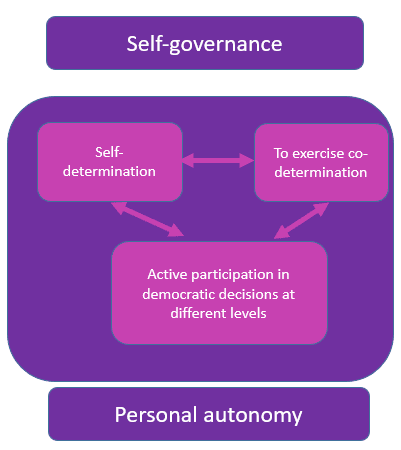
But before we delve into these concepts and their interrelationships, we start by getting the framework in place for everyone’s right to self-determination.
Article 1
All human beings are born free and equal in dignity and rights. They are endowed with reason and conscience and should act towards one another in a spirit of brotherhood
Article 2
Everyone is entitled to all the rights and freedoms set forth in this Declaration, without distinction of any kind, such as race, colour, sex, language, religion, political or other opinion, national or social origin, property, birth or other status.
Furthermore, no distinction shall be made on the basis of the political, jurisdictional or international status of the country or territory to which a person belongs, whether it be independent, trust, non-self-governing or under any other limitation of sovereignty.
UNITED NATIONS CONVENTION FOR PERSONS WITH DISABILITIES
The purpose of the Convention and the definition of disability are set out in Article 1 of the Convention:
The purpose of this Convention is to promote, protect and ensure the full enjoyment by all persons with disabilities of all human rights and fundamental freedoms on an equal basis with others, and to promote respect for their natural dignity.
Persons with disabilities include persons who have long-term physical, mental, intellectual or sensory impairments which, in interaction with various barriers, may prevent them from fully and effectively participating in society on an equal basis with others.
The Convention contains a general prohibition on discrimination on the grounds of disability.
The Convention creates virtually no new rights, but is intended to make visible existing rights in order to ensure that citizens with disabilities have the opportunity, not only theoretically but also in practice, to exercise the same basic rights as all other citizens.
When acceding to the Convention, the States have undertaken to ensure that citizens are not discriminated against on the basis of their disability.
However, the effectiveness with which the right to non-discrimination is protected by the CRPD varies.
The Convention distinguishes between economic, social and cultural rights (e.g. the right to social security, to health and to participation in cultural life) on the one hand and civil and political rights (e.g. the right to respect for physical and mental integrity and for private life, including the right to self-determination and the right to freedom of expression).
Thus, discrimination on the grounds of disability is generally prohibited.
However, as far as the state’s obligations with regard to economic, social and cultural rights are concerned, these only have to be fulfilled along the way at the pace and to the extent that each country has the resources to do so.
The problem, then, is that certain political and civil rights – not least in relation to disabled citizens – can only be fulfilled through social and economic benefits.
Thus, a citizen with a disability has the right to decide over his or her private life, but he or she may need the help of others in order to be able to take real advantage of this right.

An example:
Laila lives in a residential facility and spontaneously wants to go to the movies one evening. She, of course, has the right to decide what she wants to do in the evening and what she will use his money to.
It is part of the right of self-determination, which must be respected because it is a civil rights.
However, if she needs social assistance (companionship, support person) to carry out her Plans, then it is a social right that “just” needs to be fulfilled along the way so that citizens with disabilities are not discriminated against.
Thus, in practice, it can be difficult to exploit fundamental rights such as the right to self-determination in relation to one’s private life when one needs professional help for the purpose.
Set service levels can be a challenge to the right not to stay discriminated against on the basis of disability.
However, public authorities have a duty or should have a duty to include considerations of disability discrimination in every decision when it comes to social assistance to citizens with disabilities.
RIGHT OF SELF-DETERMINATION AND DUTY OF CARE
The right to respect for one’s private life and thus the right to self-determination applies to all citizens.
This means that citizens with quite serious mental impairment must also be guaranteed protection of the right to self-determination.
This is, of course, a challenge, as unconditional protection of the right to decide over one’s private life entails a risk that some of the weakest citizens may be subjected to neglect if they use their right to self-determination to take decisions that in some cases may be inappropriate or even directly harmful to themselves.
This can present some dilemmas for the employees who must both care for these citizens and ensure their right to self-determination.

Imagine, for example, that you work with providing educational support and help to these people, all of whom have significantly reduced mental capacity:
- Anna has inflammation in a tooth and does not understand that a trip to the dentist can help her get rid of the pain.
- Berta has diabetes and eats five bags of liquorice confectionery every day.
- Carsten becomes very aggressive when he drinks alcohol – he likes to drink two cartons of white wine every day.
- Dorthe will be pierced all the way up her right arm.
- Erik suffers from COPD and likes to have a smoke all day.
- Frida does not want toenails cut and can therefore no longer fit her shoes.
- Gudrun lies in her bed most of the day with her back to the world – she is wet with pee and does not want to be washed or out of her bed.
- Herdis wants to go out on a frosty night in a thin nightgown, but can’t orient herself in traffic on her own.
- Janus loves his moped, but he has no understanding of traffic rules.
It is not the case that the right to self-determination must not be encroached upon at all.

But these exceptions must be legislated for before they are allowed. It is the legislators of a country – and not the employees or management – who decide in which situations it may be permissible to interfere with the citizen’s private life and thus the right of self-determination.
Put simply, it is not legal to encroach on the right of citizens to decide over their private affairs unless there is a rule of law which allows access to it.
This also applies even if you act in the care of a mentally or physically fragile citizen.
In the social field, legislators in most countries have adopted various special care rules, which include interference with the right of self-determination.
In addition, in many countries there are employees’ working environment rules, which can also restrict citizens’ right to self-determination, e.g. in cases where mentally vulnerable citizens’ homes are also the employees’ workplace.
It may, among other things, be rules on smoking and on work tools that citizens do not want installed in the home that create dilemmas in relation to the right to self-determination.
CASE 1:
HERMAN AND THE GARBAGE BAGS
Herman is 78.
He suffers from Alzheimer’s dementia, which makes him remember very poorly and therefore cannot fend for himself in everyday life.
The disease is getting worse all the time.
Sometimes he thinks that he’s 12 years old and has to go to school, and he can’t always remember if he’s eaten during the day.
Until recently, he lived with his parents, but now it has become too big a task for them to help him in everyday life.
Herman has therefore moved to a nursing home.
At the nursing home, each department has a large garbage bag, which the employees have to carry out in a large container every day.
Herman does not think that the female employees should carry around heavy garbage bags and takes pride in doing it for them – even though due to his age he is now a little unsure of his legs.
Some of the employees think it’s really good to see that Herman participates and performs a task that he finds meaningful.
They believe that it gives him a better quality of life.
Others don’t think he should do it because it’s too heavy for him and he can fall and hit himself.
This winter, when there is snow and ice outside, it is even more unsafe to go out with the garbage bags – both for the employees and for Herman.
Some of the employees will therefore no longer take responsibility for letting Bent go out with the bags.
Bent’s relatives say that he has always been a gentleman and taken pride in being of benefit to others, even if it has entailed certain risks.
The relatives say that his life will not make sense if he is not allowed to help.
Herman himself does not see that there is a problem at all: “I guess we can all get to injury,” he says.
TASK FOR REFLECTION
CASE 1
What is at stake in terms of user influence and self-determination in the situation?
How would you as employees relate to Herman and his relatives?
CASE 2:
ASTRID’S NEPHEW
Astrid, 34, lives in a social psychiatric residential facility because she cannot cope with ordinary tasks such as hygiene, cooking and cleaning.
Astrid only has her early retirement to live on, and therefore the economy is tight.
She borrows money from the other residents and is in relatively large debts – which means that the other residents look askance at Astrid and demand their money back.
Astrid’s nephew, 14, comes to her delight to visit once a week.
Astrid stabs her nephew with DKK 500 every time he visits.
TASK FOR REFLECTION
CASE 2
What is at stake in terms of user influence and self-determination in the situation?
As employees, how would you relate to Astrid and the situation described?
WHAT DOES THE DANISH CONSTITUTION/CONSTITUTION SAY
The constitutional rules on freedoms must also, in specified situations, protect the right of citizens to decide over their own affairs.
The rules are thus intended to protect the State from arbitrary interference with these matters.
These are rules on the right to move freely, private property, secrecy of correspondence, freedom of assembly, etc.
REMEMBER
That you as an pedagogical staff and social worker are a representative of the Danish state.
The right to self-determination stems from human rights.
All people have the right to make choices and decisions that concern themselves, provided that it does not conflict with the right of others to self-determination. Special circumstances apply to minors and persons under guardianship.

The right to self-determination is crucial to consider.
It has an impact on how educational staff in social services can provide social care and support.
It is therefore important to know the legal framework for both self-determination and social care when ensuring that the users of the social services have an impact on their own lives and their everyday lives.
The important thing, however,
is that one person’s possible desire to regulate behaviour must not be made a justification for the fact that another person does not have the opportunity to choose for himself the life she or he would like to live.
One’s ‘rulebook’ must not have consequences for another to such an extent that the other’s self-determination over one’s own body and the freedom to make choices themselves are violated.
Girl circumcision and forced marriage are examples of curtailments in the right to self-determination.
Definitions
Self-governance, self-government, or self-rule is the ability of a person or group to exercise all necessary functions of regulation without intervention from an external authority.
Autonomy is to be independent of others and/or to decide on one’s own affairs, in particular on areas and institutions which have a high degree of independence without, however, having full self-determination.
What is personal autonomy?
Individual autonomy is an idea that is generally understood to refer to the capacity to be one’s own person, to live one’s life according to reasons and motives that are taken as one’s own and not the product of manipulative or distorting external forces, to be in this way independent.
Self-determination, that is, the right to decide for one self and one’s own life.
Participation, that is, the right to decide with others.
Democracy is the right to decide along with many others.
Self-determination, the right to decide for oneself and one’s own life.
Write the 5 things/areas that are most important for you to decide for yourself

Is it important for you to decide your own life?
Why is it important for you to decide on your own life?
What feelings would it arouse in you as and when your self-determination is reduced.
Write the 5 things/areas that are most important for you to decide for yourself
Co-determination is the right to decide together with others.
Where/when in our lives – in your life you have had to give up your sovereign self-determination in favour of co-determination with one or more people in your private life.
What do you lose – what have you lost? By areas you have / you have practiced self-determination – is reduced to participation.
Have you experienced that in certain areas – you have lost your self-determination completely.
ABOUT CIVIC AND USER RIGHTS

User influence, user involvement, empowerment, self-determination and co-determination – there are many concepts in play when it comes to ensuring that users of social services have an impact on their lives and everyday lives.
Questions of self-determination and co-determination are about fundamental citizens’ rights for all, while user empowerment and user involvement are about the rights of recipients of social benefits.
Both types of rights are relevant for users of social services.
The table below shows the distinction between being a citizen and a user, where the starting point is differences at the rights level:
| CITIZEN
Everyone in society (fellow citizens) for whom The Constitution and human rights applies. Right: 1. Have the right of decision. 2. The right to self-determination can only be restricted by other legislation, such as criminal law and guardianship. ————————————————– Self-determination + co-determination |
USER
All who are users/recipients of public services. Right: 1. Has an impact on performance. 2. Must be involved. 3. The right of decision rests with the authority. ————————————————– User involvement + user influence |

A user of a social service is at the same time an ordinary citizen and user of a public social service.
Being a user of a public offer and depending on the help of others, can depending on how this help is organised – mean that the possibility of exercising ordinary citizens’ rights in relation to self-determination and co-determination are restricted.
At the same time, the organisation of the aid and support provided has an impact on the extent to which it is possible to exercise its user rights in relation to involvement and influence on aid and support.
Pedagogical/social workers and other professionals in the social services are responsible for taking users’ rights – as both citizens and users – seriously and integrate they are a natural part of the help and support provided.
It is part of the pedagogical task.
Working with user influence in social services is therefore about creating culture and frameworks that support users’ opportunities to exercise both user and civil rights.
CIVIL RIGHTS:

SELF-DETERMINATION AND CO-DETERMINATION
Self-determination and co-determination are fundamental civil rights.
Self-determination is about the right to decide over oneself and one’s life. At home, the right of self-determination is sovereign, here you can do pretty much whatever you want.
Co-determination is the right to influence shared with others, and compromises typically have to be made. In a family, for example, you share the right of decision with your boyfriend, children and/or your parents.
In residential areas, you share the right of decision about, for example, common areas with the other residents, while in drop-in centres you can jointly, for example, draw up rules for how you can behave on site.
More generally, we all have a say in Danish society through our right to vote in, for example, parliamentary and municipal elections.
USER RIGHTS:
USER INFLUENCE AND USER INVOLVEMENT
The right to involvement and influence is specifically linked to situations where the citizen is also a user of a social service.
For example, it may affect the help the person receives on a residential facility, a shelter, a drop-in centre, via a contact person, home help, financial support, an educational offer or employment guidance.
CASE 3:
JOHN AND MARIA WANT A CHILD
John and Maria are in their 30s and both have learning disabilities.
They live together in a sheltered apartment, located in a small cluster of housing for people with learning disabilities.
There is also a communal house where everyone eats dinner on weekdays.
In everyday life, a small group of Pedagogical/social workers are attached to the homes, they help the residents with the things that can be difficult.
John and Maria have wanted a child for many years.
They are used to being with children, and Maria is a very well-liked employee in a sheltered position in a nearby kindergarten.
The teachers around John and Maria have helped them think through all the challenges and consequences of having a child, and the couple feel well prepared to become parents.
However, not everyone thinks it’s a good idea to have their own child, especially Mary’s parents are opposed to it.
Mary’s mother has now begun to approach the Pedagogical/social workers and say things like;
“John and Maria have a hard enough time coping with their own everyday lives – they can’t manage to take care of a child too, you have to support us in that.”
TASK 3 FOR REFLECTION
What is at stake in relation to user influence and self-determination situation?
How would you as employees relate to John and Maria and their Relatives?
CASE 4:
PETER AND THE PLACE FOR HOMELESS PEOPLE
Peter is an engineer, but now unemployed.
He divorced his wife two years ago and, due to depression and increasing alcohol consumption, failed to pay his rent and bills.
He has now been let go of his apartment and is living in a homeless shelter.
He wants to feel better and is a follower treatment for both depression and his alcohol abuse.
At the shelter there are very fixed rules for everyday life,
For example, everyone must be at breakfast no later than 8:30 a.m.
Peter sleeps poorly at night, and often doesn’t really fall asleep until five or six in the morning.
He therefore wishes that he could not be allowed to have breakfast until 10:00.
Peter does not have very good contact with his contact person, a young newly graduated woman of 23 years.
She’s good enough at her job, but he finds it uncomfortable to have to sit and tell her about his life, his problems, and how he feels.
He thinks that it might be better for him to have a contact person who is a little older, but at the same time that he probably can’t afford to feel that way.
After all, she’s doing her job – and not doing anything wrong. But he has a hard time with the relationship and finds that the conversations about his action plans are difficult.
TASK FOR REFLECTION
READ CASE 4 AND DISCUSS:
What is at stake in terms of user influence and self-determination in the situation?
What are the opportunities to change the situation Peter is in? as employees do?
SELF-DETERMINATION UNDERSEAS THE FULFILMENT OF A FUNDAMENTAL HUMAN NEED;
BE INCONTROL
- What does it take to exercise; self-determination.
- What is the link between personal responsibility and the right to self-determination?
- What does it take to be able to take personal responsibility?
- What do a person have to be prepared for if the person want to decide for one self?
Write down your first reflections about these 4 questions.

Do you agree in the following point of view
Often, people who do not take responsibility for their own lives have a sense of being a victim of circumstances. In such a situation, self-pity prevails, and one may have the feeling that the world is against you and that one is stuck.
If YES – why do you think it is so
Do you agree in the following point of view
To have the option or right for total self-determination demand that the person is able to take responsibility for his or her own life.
If YES – why do you think it is so

What are the limitations for self-determination, who set the limitations for the residents/clients ability to practice self-determination?
- National Laws and regulations
- Institutional rules and settings
- Personal staff values and point of views?
- What else – to your mind?
The framework for accessing the concept of self-determination is always:
- Knowing national legislation – and how it is interpreted and administered
- Anyone who puts another person in a helpless state or leaves a person in his or her care in such a state is punishable by imprisonment up to 8 years.
Order of the Guardianship Act
A patient can be admitted against his or her will to a psychiatric ward if the following 2 prerequisites are met:
The patient is insane (psychotic) or is in a condition which must be equated with it, and it would be indefensible not to detain the person for treatment because:
The prospect of cure or a significant and decisive improvement in the condition will otherwise be significantly impaired (so-called health information).
Here you will use “yellow papers”, or
The person concerned presents a obvious and significant danger to himself or others (so-called danger indication) where “red papers” are used.
What is the challenge in other sectors? When it comes to self-determination
“Self-determination is one of the most important values of health care, and its opposite is coercion.
Coercion in the health service is not allowed other than in the case of very poor psychiatric patients.
In the end, therefore, you cannot force a dement to eat, even if she does not understand the consequences of not doing so,”
says Helle Mathar, associate professor at the University College Metropol and teaches ethics, among other things.
A no is a no
The biggest dilemmas arise when it comes to patients who are incapacitating, for example because they are unconscious, demented, confuse or at the lighter end of the psychiatric scale.
Direct consequences
When patients enter acute, planned or outpatient, it happens regularly that patients refuse to accept all or part of the treatment. This can give healthcare professionals a number of difficult ethical and legal considerations.
A cancer patient who won’t continue his treatment risks dying.
A homeless person who won’t have treated his wounds, risk gangrene and potential amputation and death.
A person does not want vital blood transfusion because of his religious beliefs.
A demented citizen who doesn’t want probe food, though the consequence can be fatal.
Practice self-determination might have consequences – that you don`t agree with or sympathise with
Which Institutional rules and settings limit at your workplace the level of self-determination for the target group
Reflect and write down the Institutional rules and settings at your workplace limit the level of self-determination to your mind?
Which Personal staff values and point of views among your colleagues limit to your experience the level of self-determination for the target group
Reflect and write down the values and point of views among your colleagues that to your mind limit the level of self-determination to your
Which Personal values and point of views are you able to recognise at your self – which the level of self-determination for the target group
Reflect and write down the values and point of views you have that to your mind limit the level of self-determination to your mind?